

We regularly review and update our guides to ensure keyboard recommendations, specs, and software information stay current with the latest releases and updates.
Affiliate disclosure: this article contains Amazon affiliate links. Purchases made through these links support Clickyboard at no extra cost to you.
⚡ Quick answer
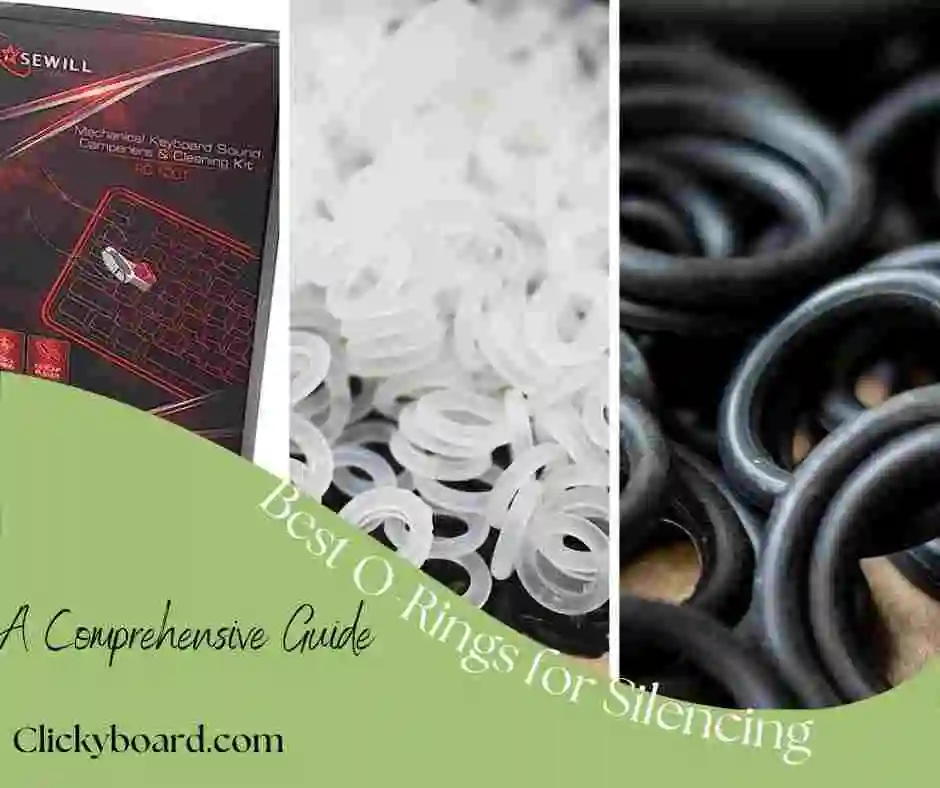
O-rings are small rubber rings that sit on the keycap stem. On a compatible MX-style keycap, the ring can contact the switch housing near the end of a press and cushion bottom-out impact. They are removable and inexpensive, though results depend on the keycap and switch geometry. What they don’t change: upstroke noise, spring ping, stabilizer rattle or a hollow-sounding case. WASD lists 0.2 mm and 0.4 mm travel reductions for its two ring models; actual change can vary with the keycap and switch.
O-rings are a low-cost way to address bottom-out clack on a compatible mechanical keyboard, but they are often misunderstood. This guide explains what they physically do, the sizes they actually come in, what changes and what doesn’t, and how they compare with stabilizer tuning and silent switches, so you can tell whether they’ll fix the noise that’s bothering you.
What O-rings actually do
At the end of travel, the switch stem or keycap can make a hard stop, producing a bottom-out clack. An O-ring on the underside of a compatible keycap can meet the switch housing before that hard stop and cushion the press. Exact contact depends on keycap shape and switch design.
Because the ring stops the cap slightly early, the key travels a little less. The actuation point is usually before bottom-out, so a properly sized ring should not prevent registration. Short-travel switches and unusually thick rings need extra care: test one key to confirm full actuation and comfortable reset.
O-ring sizes: the published numbers
Listings use confusing labels, so here are the figures makers and sellers publish. These are published specs, not our own measurements.
| Ring | Size (outer × inner × thickness) | Hardness | Travel reduction |
|---|---|---|---|
| Typical generic MX O-ring | 8 × 5 × 1.5 mm | Usually 40A to 50A | Not usually stated |
| WASD red 40A-L | About 1.5 mm thick | 40A (softer) | 0.2 mm |
| WASD blue 40A-R | Slightly thicker than the 40A-L | 40A (softer) | 0.4 mm |
Two things to know. WASD’s 0.2 mm and 0.4 mm figures describe intended travel reduction, not the ring’s physical thickness. The “A” number is Shore A hardness: a higher number means firmer rubber. Check the keycap-stem fit and test one key before buying a full set. See WASD’s installation and travel guidance.
What changes and what doesn’t
| Part of the sound or feel | With O-rings |
|---|---|
| Bottom-out impact (the “clack”) | Softer and quieter |
| Bottom-out feel | Softer; firmer rings (50A+) change it less |
| Total key travel | Often shorter; WASD lists 0.2 or 0.4 mm for its models, but fit varies |
| When the key registers | Usually unchanged if the ring fits and the switch can still actuate fully |
| Upstroke (the key snapping back up) | No change: that noise is inside the switch |
| Spring ping, switch scratch | No change |
| Stabilizer rattle on the spacebar and long keys | No change |
| Hollow or echoing case | No change |
How to judge it on your own board: we haven’t published recordings of our own yet, so the best evidence is your own before and after. Put rings on half the keys only. Record yourself typing the same sentence on each half with your phone at a fixed distance, and with any automatic noise reduction turned off. Listen for the bottom-out specifically; if the loudest sound is a rattle or ping, O-rings won’t touch it.
The trade-offs
- Shorter, softer presses. Some people like the cushioned landing; others find it mushy, especially with soft 40A rings or on tactile switches, where it can blur the end of the press.
- Only one kind of noise. They don’t address the upstroke, spring ping, stabilizer rattle or case echo, so on some boards the improvement is smaller than you hope.
- Fiddly to fit. Every key needs a ring, and rings can fall out of keycaps when you pull them later.
- Fit varies. Most fit MX-style stems, but very thick rings can stop some keycaps sitting properly. Try a few keys before doing the whole board.
How to choose
| If you want… | Choose |
|---|---|
| The least change to feel | A thin, low-reduction ring (0.2 mm, such as a 40A-L type) |
| The most dampening | A 0.4 mm reduction ring in softer 40A |
| Less clack but a crisper bottom-out | A firmer ring whose size fits your keycap |
| To find out if you like them at all | A cheap bulk pack, tried on a few keys first |
Whatever you buy, check the listing says it fits MX-style (Cherry MX) stems, and get enough for every key plus spares: about 61 for a 60% board, 87 for a TKL and 104 for full-size.
Affiliate links: if you buy through them we may earn a small commission at no extra cost to you.
O-rings vs stabilizer tuning vs silent switches
These fix different noises, so the right one depends on what you hear. None is simply “best”.
| Fix | What it quietens | Cost and effort | Changes feel? | Reversible? |
|---|---|---|---|---|
| O-rings | Bottom-out clack only | Low-cost; installation time varies by board size | Yes: shorter, softer bottom-out | Yes |
| Stabilizer tuning | Rattle and ticking on the spacebar, Enter, Shift and Backspace | Lube and tools; about an hour | Smoother long keys | Mostly |
| Silent switches | Bottom-out and upstroke, inside the switch | A full set of switches; easy on hot-swap boards | Slightly softer, slightly shorter travel on some models | Yes, on hot-swap boards |
| Case foam | Hollow echo from the case | Cheap; means opening the case | Little or none | Yes |
If your loudest sound is a rattly spacebar, start with the stabilizers. If it’s every key clacking at the bottom, O-rings or silent switches are the fix. If the keyboard sounds hollow, look at foam. Plenty of quiet boards use more than one.
How to install O-rings
- Pull a keycap with a keycap puller, straight up. On hot-swap boards, go gently so you don’t pull the switch out with it.
- Push one ring over the stem on the underside of the keycap until it sits flat at the base.
- Press the keycap back on firmly until it’s fully seated.
- Try a few keys first. Confirm each key still registers and returns normally, then fit the rest if you like the feel.
- Type on it for a day. Too soft? Try a thinner or firmer ring. Not enough difference? Your noise is probably coming from somewhere else; see the table above.
Frequently asked questions
Do O-rings make a keyboard quieter?
Yes, but only the bottom-out: the clack when the keycap hits the switch at the bottom of the press. They do not change upstroke noise, spring ping, stabilizer rattle or case echo, so how much quieter a board gets depends on where its noise comes from.
What size O-rings fit a mechanical keyboard?
For standard MX-style keycaps, the common size is about 8 mm outer diameter, 5 mm inner diameter and 1.5 mm thick. Check that the listing says it fits Cherry MX-style stems.
What do 40A-L and 40A-R mean?
The number is hardness on the Shore A scale: 40A is softer, 50A firmer. On WASD rings, the L version reduces key travel by 0.2 mm and the R version by 0.4 mm. The figures describe travel reduction, not ring thickness.
Do O-rings change when a key registers?
Usually not when the ring fits correctly, because actuation occurs before the end of travel. Test the exact keycap and switch, especially with short-travel switches or thick rings.
Are O-rings or silent switches better?
They solve different problems. O-rings are cheap and reversible but only soften the bottom-out and shorten travel. Silent switches damp both the bottom-out and the upstroke inside the switch, but cost more. Neither fixes stabilizer rattle.
Do O-rings damage keycaps or switches?
They are removable, but check that the keycap seats properly and each key actuates and returns. Pull keycaps gently and straight up, especially on hot-swap boards.
How many O-rings do I need?
One per key: about 61 for a 60% board, 87 for a TKL and 104 for a full-size keyboard. Buy spares, as a few always go missing.
The bottom line
O-rings are worth a few dollars if the sharp bottom-out clack is what bothers you, and you don’t mind slightly shorter, softer presses. Start with a thin, low-reduction ring on a few keys. If your noise is rattle, ping or a hollow case, put the effort into stabilizer tuning, silent switches or foam instead.
Specifications reviewed against WASD’s O-ring guide and CHERRY’s switch explanation. Ring dimensions and effects vary by keycap and switch; check the exact set you buy.